
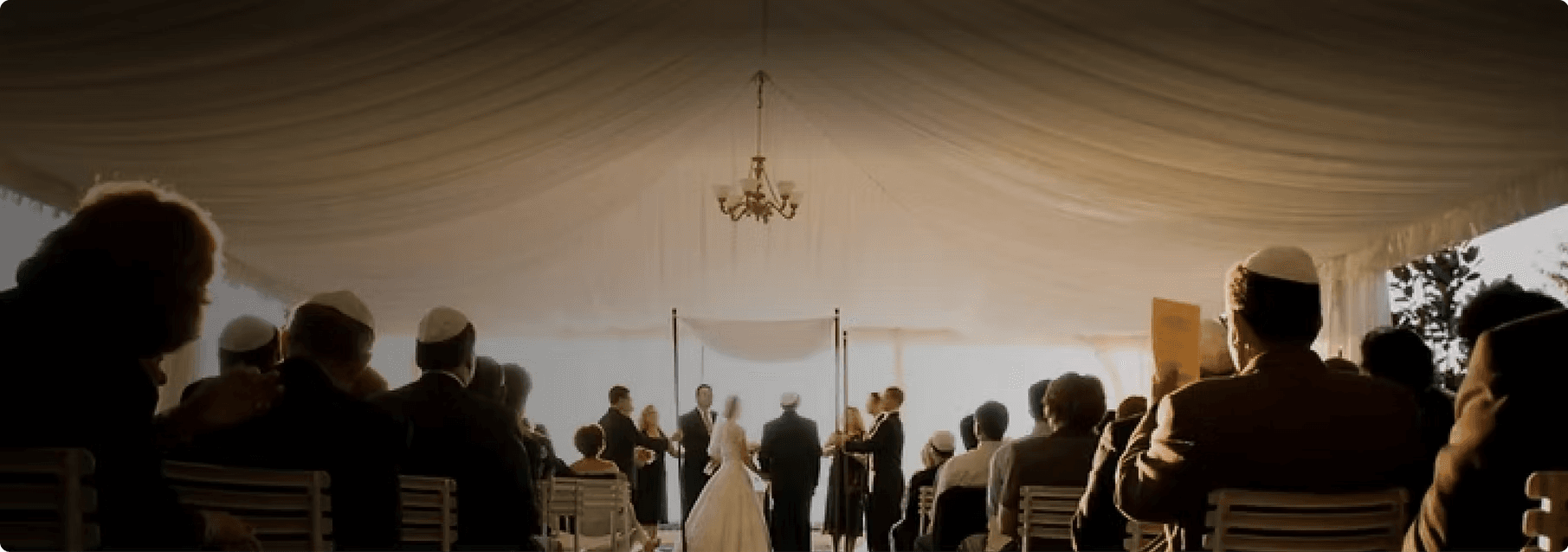
There is a moment at every Jewish wedding when formality dissolves. Jackets come off. Circles form. Chairs rise. The music lifts the room from celebration into something collective and electric. Jewish wedding dance is not just a performance for the couple. It is also a shared language between generations, guests, and tradition itself.

From the Hora to spontaneous freestyle sets, Jewish wedding dancing is where memory, joy, and identity meet the body. It is exuberant, emotional, and unmistakably alive. Long after the chuppah has passed and speeches fade into the background, the dance floor becomes the heartbeat of the night.
This blog explores the meaning, evolution, and enduring power of dance at a Jewish wedding, honoring tradition while embracing the modern ways Jewish joy continues to move.
Why Dance Is Central to the Jewish Wedding Experience
In Jewish life, joy is not passive. It is expressed outwardly. Dancing at a wedding is not optional entertainment, it is a mitzvah, a way of actively bringing happiness to the couple.
A Jewish dance wedding is built around participation. Guests do not observe from the sidelines. They step in, lift up, clap, and sing together. Dance removes hierarchy. Elders dance beside friends. Children weave through circles. It's a state where everyone belongs. This is why Jewish wedding dance feels different from other celebrations. It is fueled by presence and aesthetics.
Dance as Collective Memory, Not Just Celebration
One of the most powerful aspects of Jewish wedding dance is that it carries memory through motion. Many guests arrive having danced these same steps decades earlier, at parents’ weddings, siblings’ weddings, or community celebrations. When the music begins, muscle memory takes over. Bodies remember before minds do. This is why dancing at a Jewish wedding often feels emotional even before the couple is lifted. Guests are not only celebrating what is happening now. They are reconnecting with moments that shaped their Jewish lives.
In this way, Jewish wedding dancing acts as cultural continuity. It preserves rhythm, structure, and feeling across generations, even as melodies and arrangements evolve. The dance floor becomes a place where past and present overlap naturally, without ceremony or explanation.
The Hora: A Tradition That Still Commands the Room
No discussion of traditional dance at Jewish wedding culture is complete without the Hora. It remains the emotional ignition point of the reception. When the first notes hit, the energy shifts immediately. Circles form instinctively. The couple is lifted high, suspended between heaven and earth, supported by their community. It is joy with weight, joy with responsibility.
What makes the Hora endure is not nostalgia. It is adaptable. A skilled band knows when to stretch it, intensify it, or let it crescendo naturally into open dancing. The Hora works because it invites everyone in, regardless of age, background, or dance ability.
At its best, it becomes a shared release that sets the tone for the rest of the night.
Beyond the Hora: How Jewish Wedding Dancing Has Evolved
While tradition anchors the experience, modern Jewish weddings have expanded the dance floor far beyond one genre or rhythm.
Today, Jewish wedding dancing often moves fluidly through:
Classic Hebrew and Jewish folk melodies.
Modern Israeli and global Jewish sounds.
Contemporary pop, funk, and dance music.
Custom cultural blends reflecting the couple’s background.
This evolution has strengthened the tradition. The dance floor now reflects the full identity of the couple, honoring heritage while welcoming personal expression. A strong dance at a Jewish wedding does not follow a playlist. It follows the room.
Blending Diaspora Sounds on the Dance Floor
Modern Jewish weddings often reflect families whose stories span continents. Eastern European roots meet Middle Eastern rhythms. Sephardic melodies blend into Ashkenazi structures. American pop culture weaves through Hebrew lyrics.
This diversity shows up most clearly in Jewish wedding dancing. A single set might move from a traditional folk melody into a contemporary Israeli hit, then pivot into a modern dance track that still carries Jewish phrasing underneath.
The key is cohesion. When done thoughtfully, these transitions do not feel disjointed. They feel like a conversation between many generations.
This is where experienced live musicians matter. A band that understands Jewish musical language can move between styles without losing momentum, keeping the dance floor unified rather than fragmented.
What Makes a Jewish Wedding Dance Floor Truly Work
A packed dance floor does not happen by accident. It is guided. Curated. Read in real time. The most memorable Jewish wedding dance experiences share a few common elements:
Musical Leadership
Live musicians who understand Jewish rhythm, phrasing, and crowd dynamics can sense when to push energy and when to let it breathe.
Flow Over Segments
Rather than isolated dance “moments,” the night unfolds as a continuous arc, from Hora to high energy sets to emotional swells.
Guest Inclusion
The goal is not perfection. It is participation. The best dance floors welcome every level of comfort and movement.
This is where choosing the best Jewish wedding band matters. Not for volume or flash, but for intuition.
Reading the Room: The Invisible Skill Behind Great Dancing
One of the least visible but most critical elements of a successful Jewish dance wedding is the ability to read the room in real time. Energy does not rise in a straight line. It swells, dips, resets, and builds again. The best dance floors acknowledge this rhythm rather than fighting it.
A strong musical team knows when guests need a brief emotional pause, when to reignite the floor, and when to escalate intensity. They understand that traditional dance at Jewish wedding moments require space, while late night sets thrive on continuous motion. This awareness turns dancing into an experience rather than a sequence of songs. Guests may not consciously notice the transitions, but they feel the result.
Tradition on the Dance Floor: Meaning Without Explanation
Jewish guests do not need instruction manuals for their own culture. They feel the meaning of Jewish wedding traditions through movement.
Partner circles, shoulder holds, call and response clapping, and communal lifts all communicate continuity. They are lived gestures passed down without needing explanation. Even guests who do not know every step still understand when to join. That instinct is the power of traditional dance at Jewish wedding culture. It speaks without words.
Modern Jewish Wedding Dance Floors: Personal, Expressive, Alive
Many couples today want a reception that feels both rooted and personal. The dance floor becomes the space where that balance comes to life. Modern Jewish dance wedding experiences often include:
Customized entrances that flow directly into dancing.
Blended sets reflecting family heritage and shared playlists.
Gender inclusive circles and freestyle moments.
Late night dance sets that feel more like a club than a ballroom.
What matters is solidarity. When tradition and modern energy are woven together thoughtfully, the night never fractures.
The Role of Live Music in Jewish Wedding Dancing
Recorded music can play songs. Live musicians shape moments. A live band responds to the tempo of the crowd, the emotion in the room, and the unspoken signals that define great Jewish celebrations. They extend songs when energy peaks and pivot instantly when the room needs a shift. This responsiveness is why couples who care deeply about Jewish wedding dance prioritize live music. The dance floor becomes a conversation, not a sequence.
Groups like The Shuk have built their reputation on this exact sensitivity. Their performances are not about setlists. They are about reading people. For couples planning high end celebrations, especially in New York and major U.S. cities, this level of awareness separates good weddings from unforgettable ones.
Jewish Wedding Dancing Beyond Weddings
The language of Jewish dance does not exist only at weddings. It carries into communal life. Many of the same musical structures and participatory energy appear at Jewish fundraisers, communal celebrations, and milestone events.
The reason is simple. Dance creates belonging faster than words ever could.
When people move together, they remember together. This continuity reinforces why Jewish weddings feel like part of a larger story rather than a standalone event.
Choosing the Right Partner for Your Dance Floor
The success of dance at a Jewish wedding depends heavily on who is guiding it.
When evaluating bands, couples should look beyond talent alone and consider:
Deep familiarity with Jewish rhythms and traditions.
Experience reading diverse Jewish crowds.
Comfort blending tradition with contemporary styles.
A philosophy rooted in participation, not performance.
This is why many couples gravitate toward The Shuk. Their work reflects a deep understanding of Jewish joy as something communal, dynamic, and alive. You can read more about The Shuk to understand how their approach to live music elevates not just weddings, but the entire guest experience.
Final Thoughts
The dance floor is where a Jewish wedding becomes collective. Where guests stop observing and start participating. Where tradition moves instead of sitting still. Whether rooted in the Hora or carried into modern rhythms, Jewish wedding dance is the living expression of joy, continuity, and connection. It is not background entertainment. It is the pulse of the celebration.
FAQs
1. What is the most important Jewish wedding dance?
The Hora remains the emotional centerpiece, but the full arc of dancing throughout the night is what defines the experience.
2. Do all guests need to know how to dance?
No. Jewish wedding dancing is about participation, not skill. Energy matters more than technique.
3. How long should the Hora last?
As long as the room supports it. A skilled band will stretch or transition naturally based on energy.
4. Can modern music still feel traditional?
Yes. A thoughtful blend honors Jewish wedding traditions while reflecting the couple’s personality.
5. Is live music necessary for a strong dance floor?
While not required, live music creates responsiveness that recorded tracks cannot replicate.
6. How does dancing differ at Orthodox vs. non Orthodox weddings?
Structure and separation vary, but the core joy and communal nature remain consistent.
7. Can Jewish wedding bands also perform at other events?
Yes. Many experienced groups also perform at Jewish fundraisers and communal celebrations.


